
 Glossary
Cohort
A cohort brings together people who share an event or starting point, such as the month of membership. Tracking it allows for the comparison of trajectories with similar maturity. The rules for entry, exit, and observation must be stable. It helps, in particular, to understand activation, consumption, and retention.
A concrete example
People who joined in January form a cohort that is tracked on days 30, 60, and 90. A comparison with February uses the same seniority, not just the same calendar date.
A point to consider
Mixing old and new members masks the normal activation delay. Align the time elapsed since entry.
Compare trajectories that have arrived at the same point
Build a matrix with the entry months in rows and seniority in columns. A cell that is too recent remains unavailable; it is not assigned a value of zero. Choose the starting event according to the question: registration for activation, first purchase for repeat purchases, or issuance for point redemption. This convention avoids artificially penalizing the most recent members.
Questions to ask your team
- Do the compared boxes correspond to the same seniority?
- Are members who are too new excluded from the deadline they haven't yet reached?
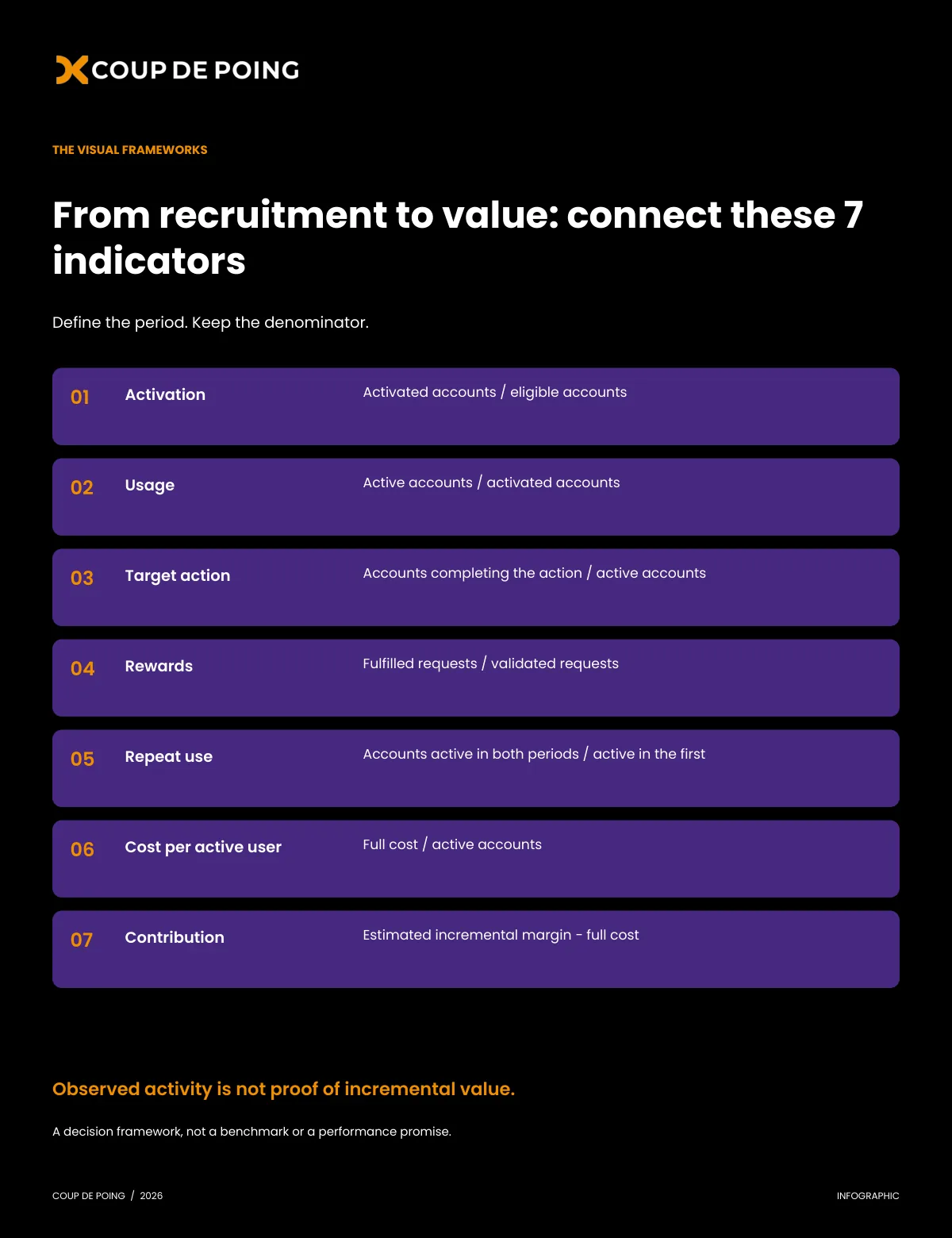
 Infographics