
 Articles
Points, status, or club: which loyalty model to choose?
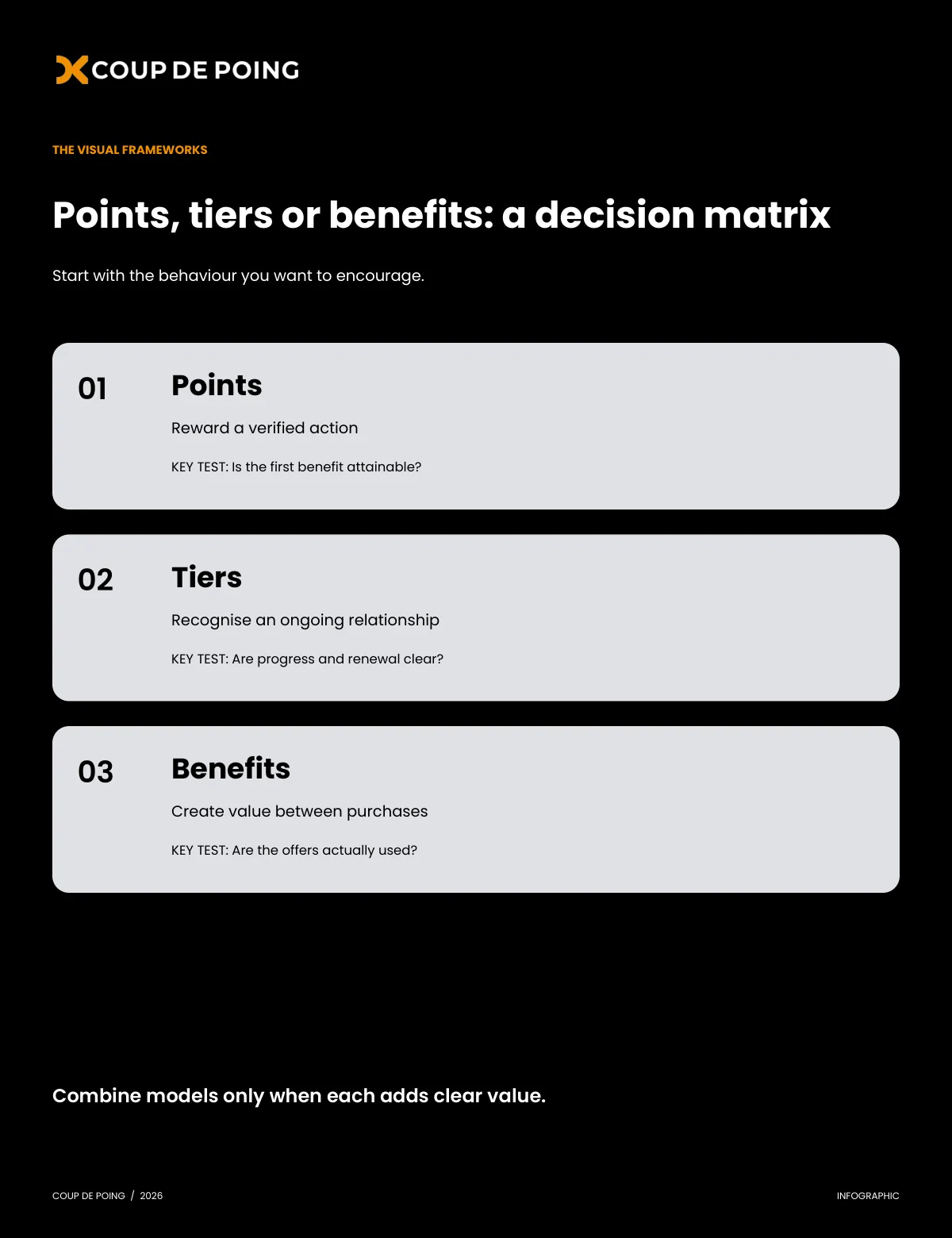
Points reward an action, status recognizes a relationship, clubs provide ongoing benefits. A grid to choose your model and avoid confusing combinations.
 Every relationship has its value.
 Every relationship has its value.

Key takeaways
- Points are suitable for observable and frequent actions.
- The bylaws require clear rules for progression and maintenance.
- A club must prove its usefulness beyond the volume of offers.
Three models, three promises
Points provide a visible unit for accumulating and using value. Statuses recognize a relationship based on explicit criteria. Clubs organize membership and access to services or benefits. The right choice depends on purchasing habits, frequency of contact, and brand promise. These models can be combined, but each layer adds rules. First, write down what the participant needs to understand in one sentence, then check whether the mechanics help or complicate things.
When are points relevant?
Points make progress tangible when earning opportunities are frequent enough. Their value, validity period, and redemption conditions must be transparent. A large but unusable balance can be more frustrating than a direct benefit. Test the time it takes to earn the first reward with a small, medium, and large customer. Distinguish between pending, available, redeemed, and expired points. Cancellations and corrections must be explainable in a readable history.
When to prioritize status levels?
A status level is suitable for a relationship that you want to recognize over time. It can unlock services, priority, or special experiences. Its value comes from these benefits, not just the name of the level. Define the progression criteria, the reference period, renewal, and the consequences of a decrease in activity. A poorly explained downgrade can damage the relationship. Progression that is too easy can make the higher level seem commonplace. Simulate the actual distribution of members before naming the status levels.
When to create a club?
A club can bring customers together around a use, an interest, or a relationship with the brand. The services and opportunities for interaction must justify membership. A free club, a paid club, or one reserved for certain clients does not generate the same expectations. The word "community" alone is not enough to create interaction. Provide a concrete reason to return: useful content, access, support, or experience. Measure the use of these services and their contribution to the relationship without confusing registration with long-term commitment.
How to choose the best combination?
Linking points and statuses can enrich the programme, provided you clearly distinguish between what is spent and what grants a right. Avoid multiple, nearly identical counters. A programme must remain understandable when a participant returns after several months. Present the benefits, progress, and next steps on a concise screen. During a migration, protect existing rights and explain the relationship between the old and new rules. Support materials must be ready before the change is announced.
The selection grid
| Model | When to choose it | Points to consider |
|---|---|---|
| Points | Frequent, measurable, verifiable actions | Accessibility of the first gift and validity of points |
| Status levels | Long-term relationship and need for recognition | Rules for maintaining and decreasing points |
| Benefits Club | Useful services between purchases | Repeated use and availability of offers |
Test the model with three customer profiles.
Take a new customer, a regular customer, and a customer whose business is slowing down. For each, calculate the time it takes to access the first benefit, the visible progress, and the incentive to return. Compare the models with the same profiles and the same budget.
Points become less motivating if no useful choices are available. A status loses its meaning if its benefits are rarely available. A club lacks substance if it offers nothing between purchases. This test doesn't identify a universal winner: it reveals the conditions necessary to deliver on the promise to your customers.
Prepare for a change in mechanics
- 01
List existing entitlements: points, promised benefits, levels, and validity dates.
- 02
Define the correspondence between the old and new rules, including cases requiring special handling.
- 03
Have teams review conversion examples and prepare a clear, individualized explanation.
- 04
Test the user transfer process, retain relevant supporting documents, and plan for enhanced support at launch.
 Infographics
 Glossary