Infographics
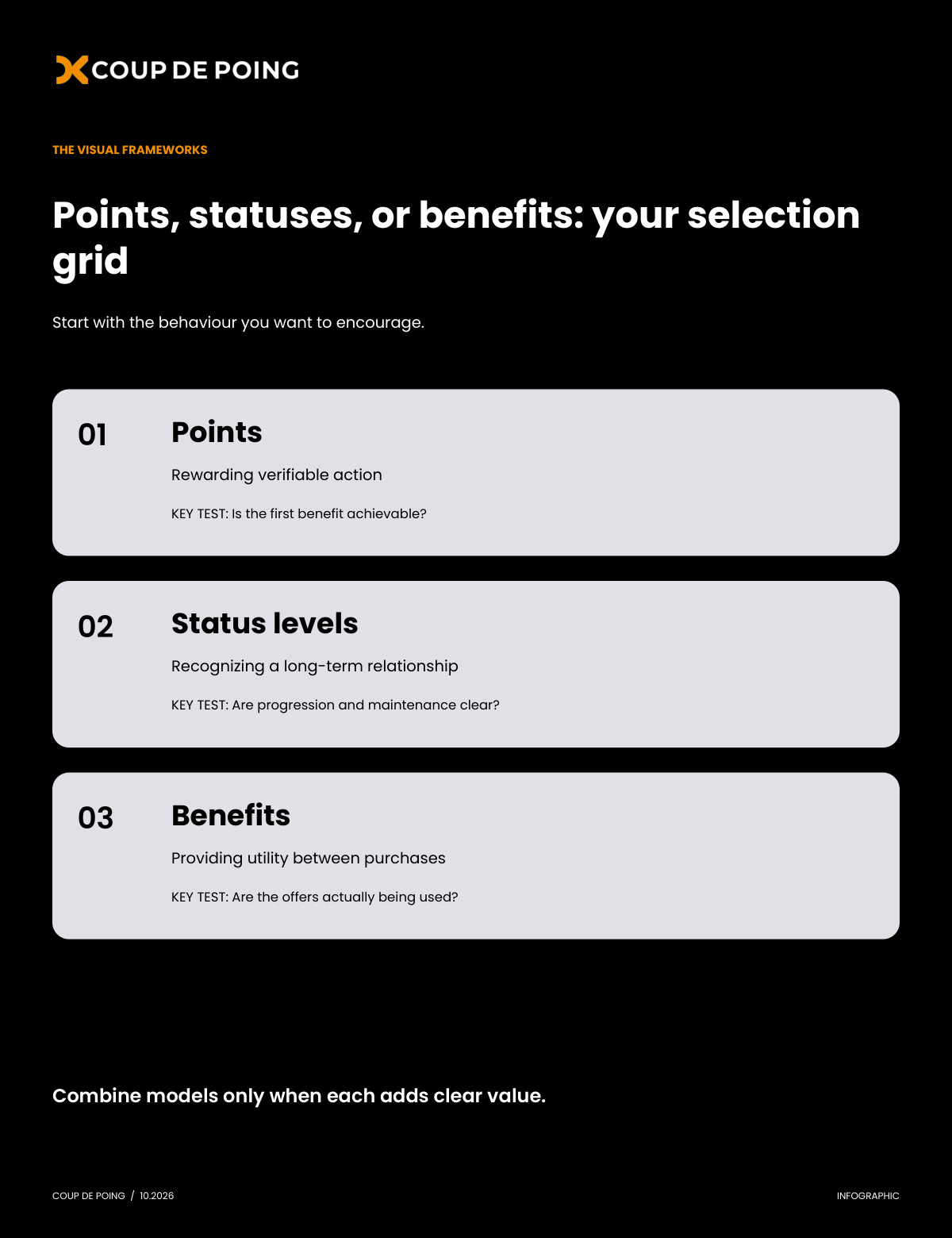
Points, statuses, or benefits: your selection grid
Three models, three value systems. An infographic to help you choose based on expected behaviour, frequency of interaction, and engagement methods.
Get the downloadable document
Key takeaways
- Points: a verifiable action.
- Status: lasting recognition.
- Benefits: usefulness between purchases.
Read the three models
| Model | The logic | The right test |
|---|---|---|
| Points | Rewarding verifiable action | Is the first benefit achievable? |
| Status levels | Recognizing a long-term relationship | Are progression and maintenance clear? |
| Benefits | Providing utility between purchases | Are the offers actually being used? |
How to use this grid
In the workshop, first choose the expected behaviour. If you cannot verify the action, a points-based system will be difficult to manage. If interactions are infrequent, examine the value of the services between purchases. Models can be combined provided that each layer provides distinct value.
The pitfall to avoid
Multiplying counters and conditions can give an impression of complexity while making the programme unreadable. Have someone new to the system explain the rule: what they understand is better than what the team thinks they said.
How to use this comparison in a workshop
Choose a target audience and a priority behavior. Then, walk through each model with three profiles: new member, regular member, and less active member. For each, describe the initial benefit, progression, and management effort. Points, statuses, and the club can complement each other if their roles remain distinct; combining them is not a requirement for quality.
Your decision worksheet
| Criteria | Question | Element to produce |
|---|---|---|
| Usefulness | Why would the member return? | A specific and readily available benefit. |
| Accessibility | When does the first benefit become achievable? | A simulation with real-world usage. |
| Readability | Is the rule understandable without assistance? | An explanation tested with participants. |
| Execution | Who keeps the promise over time? | A manager, a cost, and a support process. |
The key ideas in one visual
Download it, share it with your team and use it in your next workshop.

 Every relationship has its value.

 Articles
 Glossary