

 Every relationship has its value.

 Articles
Points, status, or club: which loyalty model to choose?
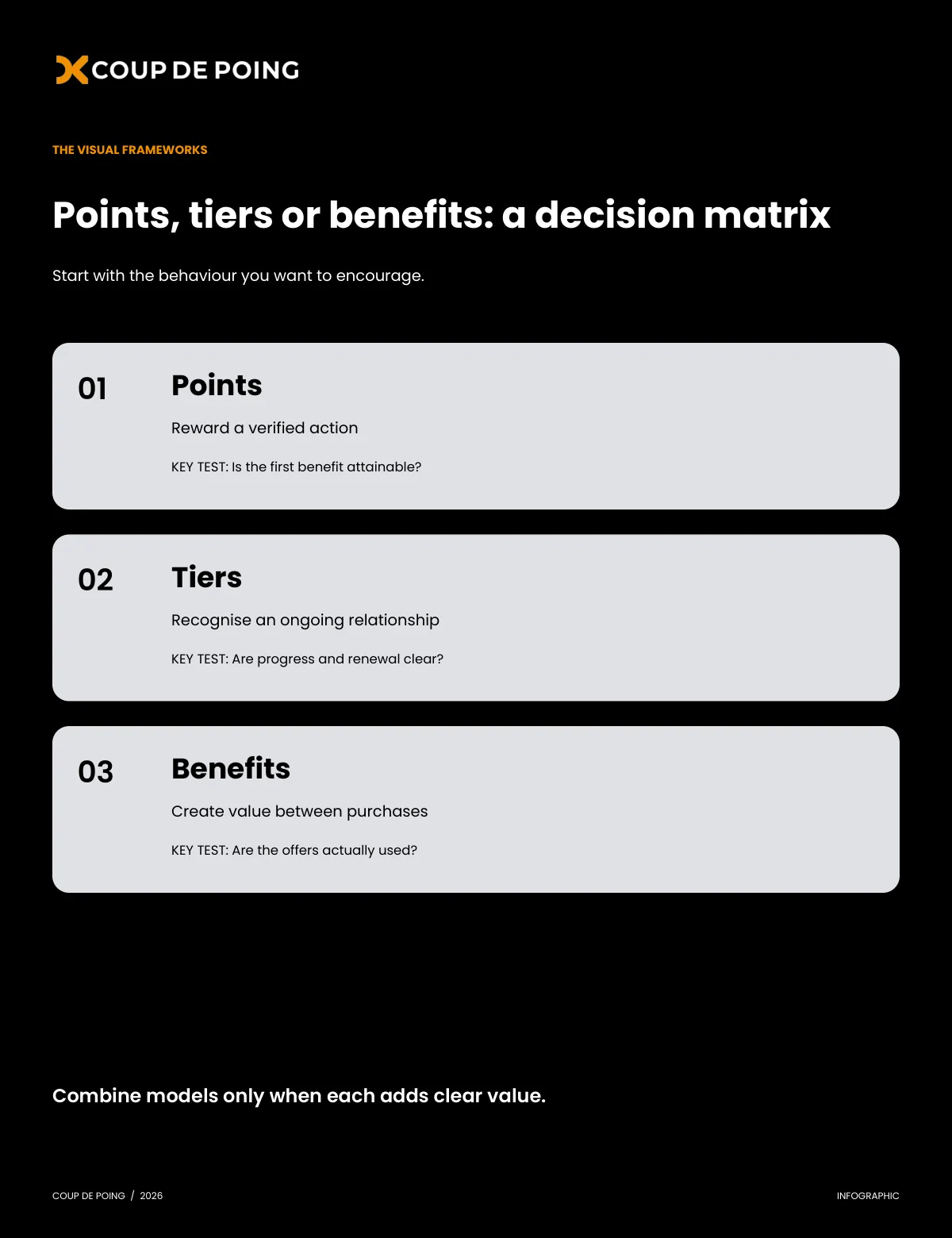
Points reward an action, status recognizes a relationship, clubs provide ongoing benefits. A grid to choose your model and avoid confusing combinations.
Methods for decision-making. Tools for action. Explore the challenges of loyalty, engagement, and rewards with the Coup de Poing teams.
Choose a topic, then the format that suits you.
Points reward an action, status recognizes a relationship, clubs provide ongoing benefits. A grid to choose your model and avoid confusing combinations.
A working white paper to align sales, marketing, finance, and IT: seven decisions, a responsibility matrix, and a launch sheet to complete.
A B2B programme plays out within the reality of the network: who buys, who uses, who wins? Here's how to link roles, data, and rewards to a measurable business objective.
From the shared link to the validated reward, referrals are based on two paths. A seven-step method to recruit willing prospects, make the promise clear, and limit disputes.
Volume, growth, acquisition, product knowledge: not all mechanisms produce the same behaviour. Compare twelve options and build a challenge that your network considers achievable.
The value of a benefits programme is measured by what employees actually use. Access, diversity of offers, support, and indicators: the choices that transform a catalogue into a useful service.
A programme can show strong sales without creating additional value. Switch from revenue to incremental margin, integrate all costs, and test the sensitivity of your model.
Physical gift, gift card, or experience: the right choice depends on the audience, the timing, and the quality of delivery. Compare the perceived value and limitations of each format.
In banking and insurance, relationships are built over time and with multiple stakeholders. Combine programmes, advice, and networking without reducing loyalty to an acquisition bonus.
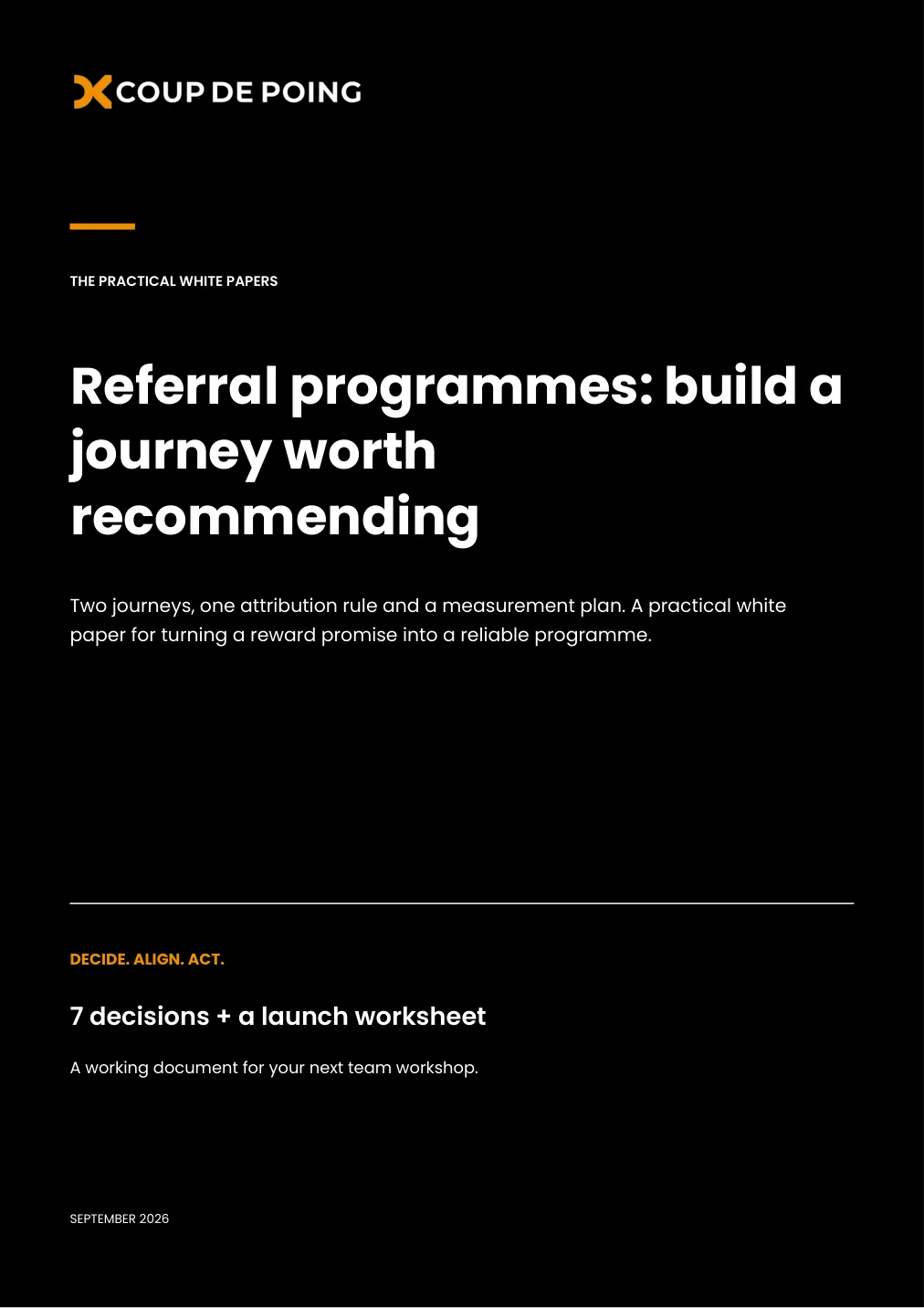
Two journeys, one attribution rule, and a measurement system. This white paper helps you move from a reward promise to a truly actionable programme.
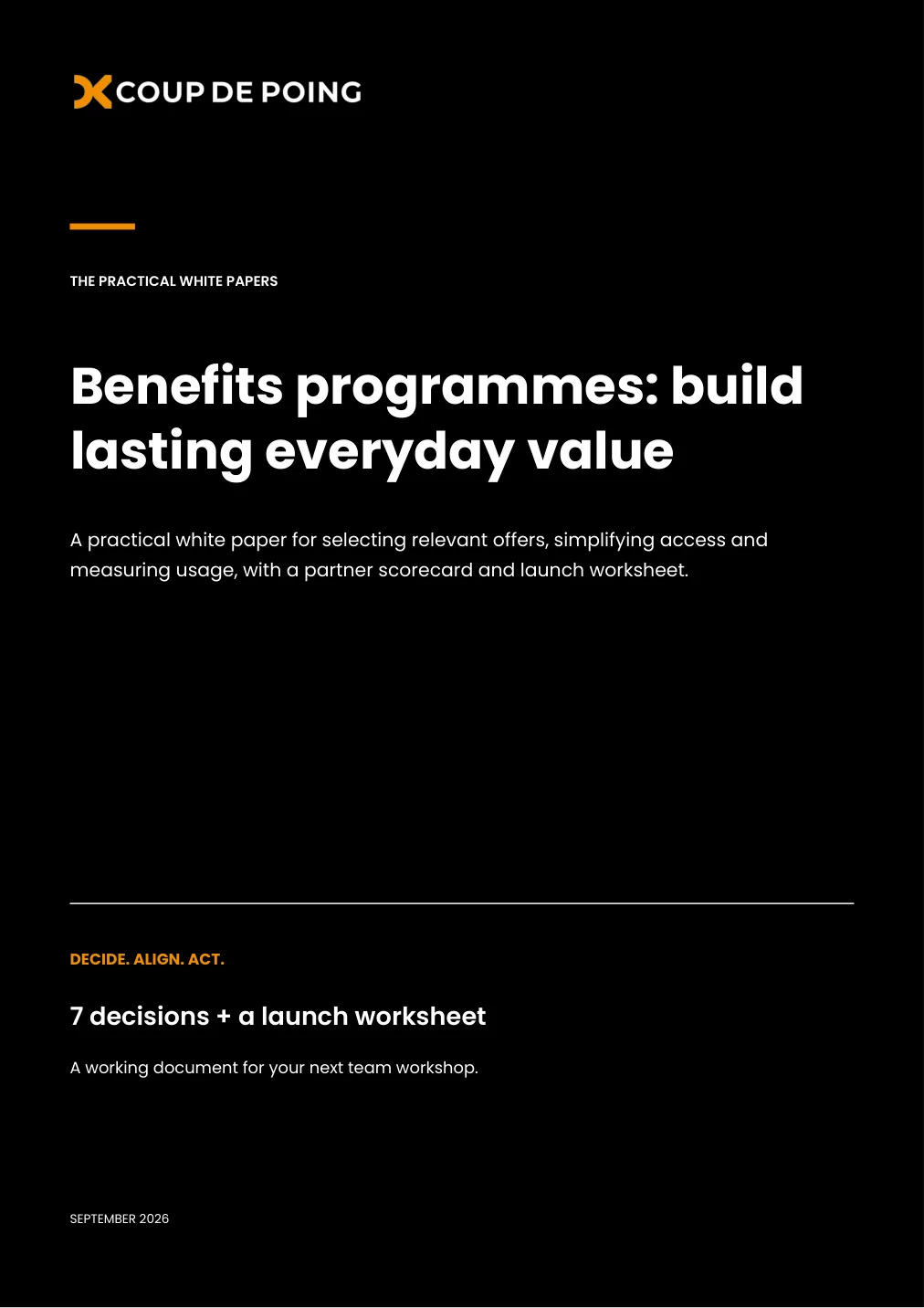
A white paper to choose the right offers, simplify access, and manage usage. Includes a partner selection grid and a launch roadmap.
Three models, three value systems. An infographic to help you choose based on expected behaviour, frequency of interaction, and engagement methods.
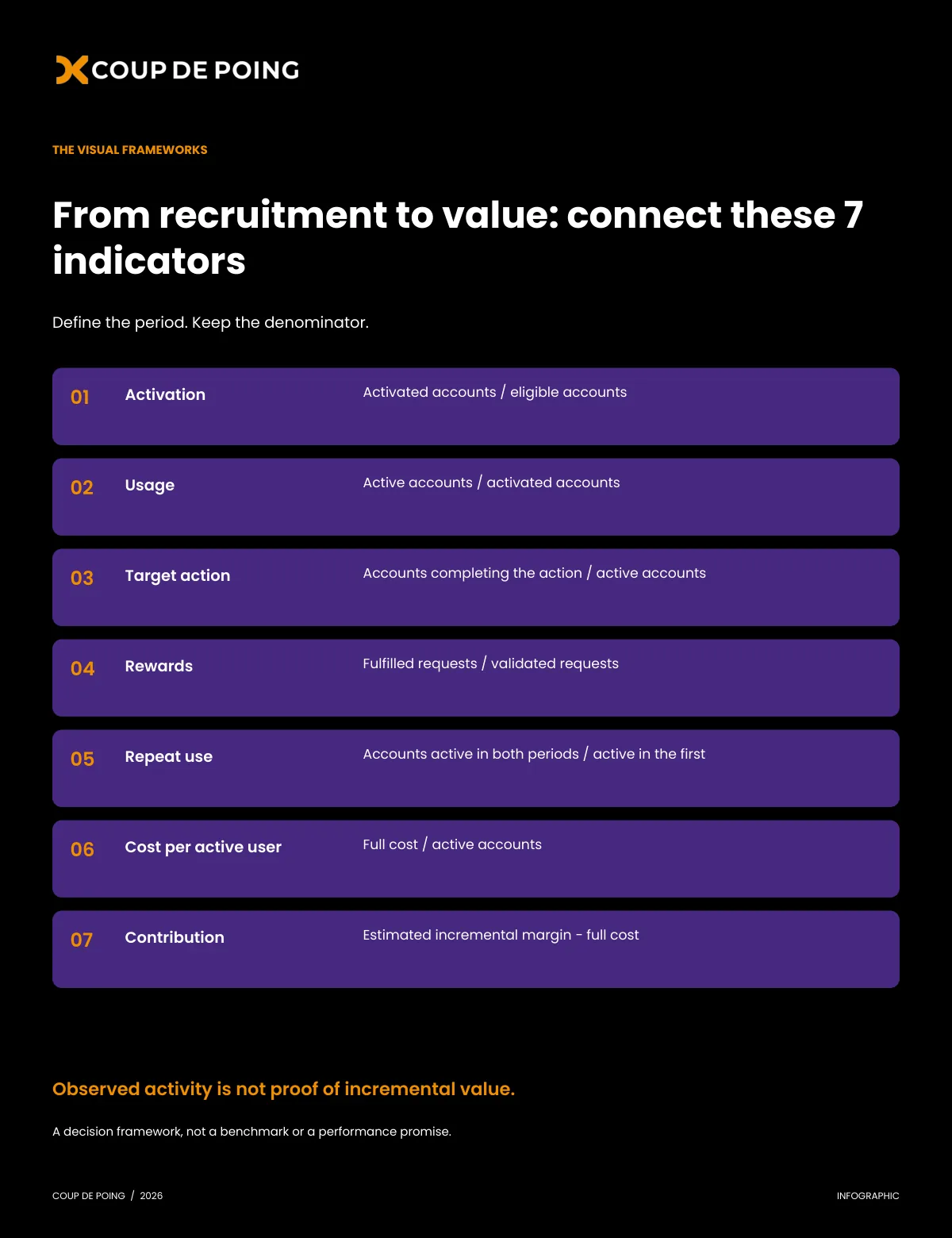
A visual grid to link access, usage, rewards, and contribution. Each indicator specifies what it measures and the denominator to keep.
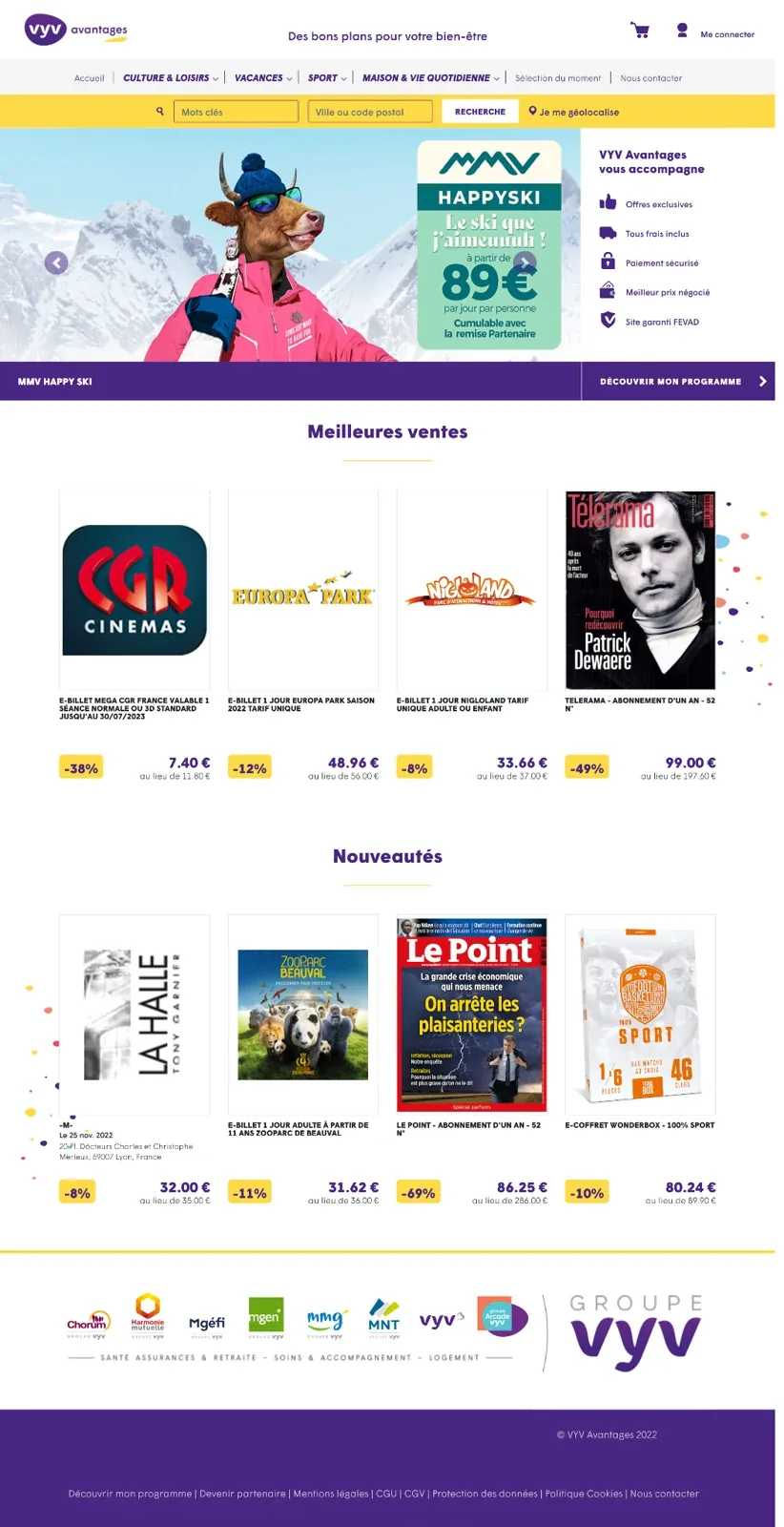
How to combine a common foundation, diverse audiences, and useful offers? Case VYV sheds light on the decisions to be made for a group-wide Benefits programme.
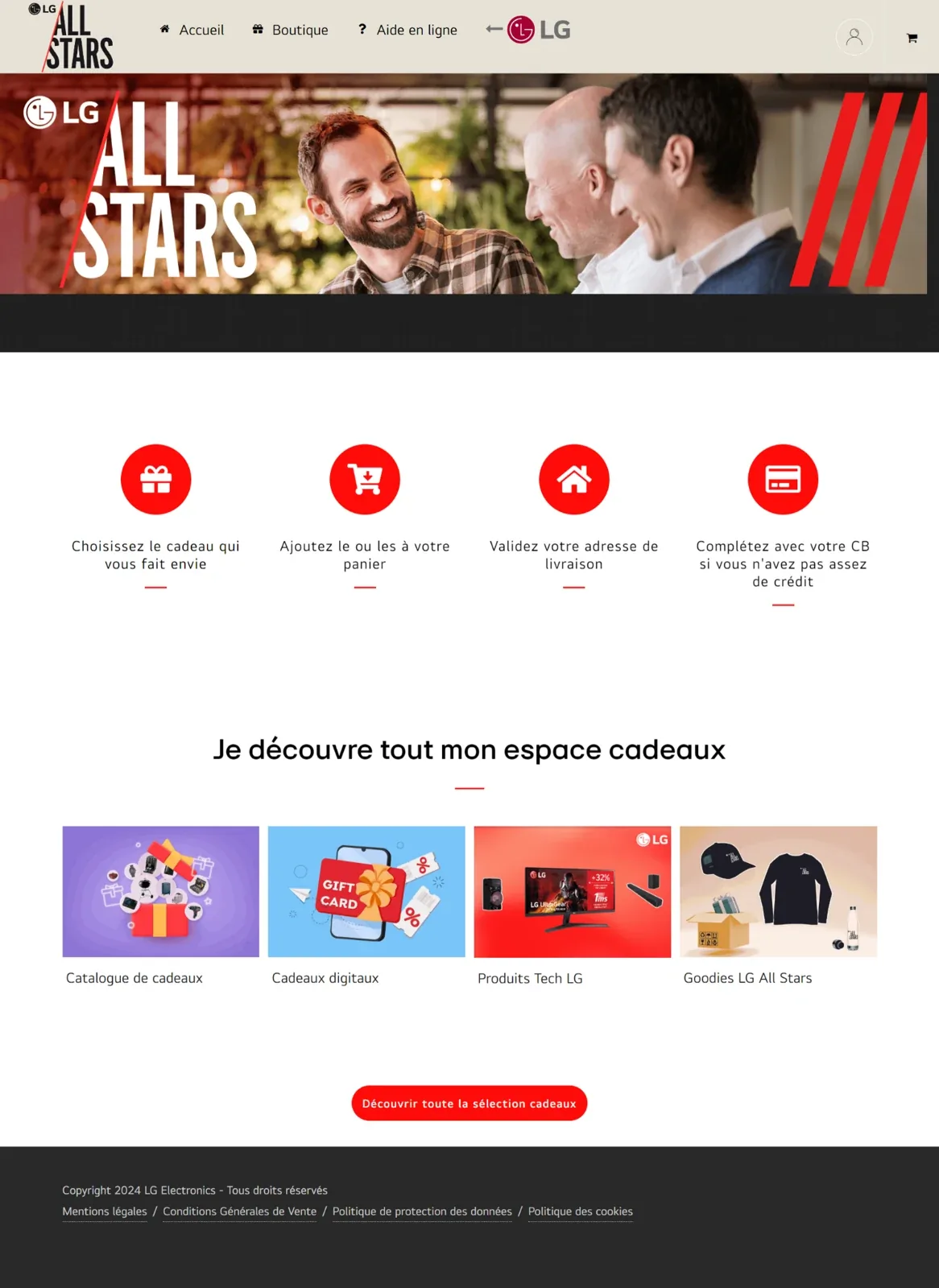
A common programme in 16 countries must combine consistency and local adaptation. The LG case helps to ask the right questions about governance, data, and rewards.
An A/B test compares two variants using a defined method to understand their effect on an indicator. Assignment, volume, duration, and analysis criteria must be established. A difference observed in a small sample may be due to chance. The decision must take into account uncertainty and side effects.
Acquisition cost relates the expenses incurred to the number of new customers acquired within a defined scope. In referral programmes, it includes rewards as well as attributable operating costs. Validation, cancellations, and the quality of acquired customers influence the interpretation of the result.
Activation refers to the point at which an eligible person takes a first action defined as significant. This action can be account creation, first participation, or first use. The term must always be accompanied by its operational definition and the period over which it is measured.
An API defines a structured way to exchange data or request an operation between systems. In a programme, it can link purchases, eligibility, points, or orders. The contract, authentication, errors, limits, and rework must be documented to make the integration usable.
Attrition describes the loss of customers or the termination of a relationship according to a business definition. Explicit cancellation and prolonged inactivity are not the same thing. The inactivity threshold should be adapted to the buying cycle. A useful analysis examines cohorts and reasons for leaving.
The average order value relates the revenue from a set of orders to the number of retained orders. Taxes, returns, cancellations, and time periods must be specified. Its evolution can result from a change in price, product range, or customer base. It does not, on its own, demonstrate an improvement due to the programme.
B2B loyalty concerns relationships with professional clients, distributors, resellers, or influencers. It must take into account purchasing cycles, account structures, and the role of the people who decide, order, and benefit from the advantages. Professional services can play a significant role.
B2C loyalty focuses on the relationship between a brand and its individual customers. Points, statuses, clubs, and services can encourage repeat business and preference. The programme must remain clear, accessible, and consistent with purchasing habits, channels, and the brand promise.
A cohort brings together people who share an event or starting point, such as the month of membership. Tracking it allows for the comparison of trajectories with similar maturity. The rules for entry, exit, and observation must be stable. It helps, in particular, to understand activation, consumption, and retention.
Consent is one of the possible bases for certain data processing. Its use requires conditions adapted to the purpose and context. In the optional audience measurement of this site, the choice is requested before collection and can be modified. Consent for one purpose does not automatically cover all others.
A consumer club organizes a relationship around access, services, content, or experiences. It can be open or reserved for specific audiences. Membership must provide tangible benefits; a closed space without activities or clear advantages is not enough to create an active community.
The consumption rate measures the use of a value or benefit relative to a reference volume. For points, it can relate points consumed to points issued, but the periods must be compatible. The maturity of the cohorts strongly influences the interpretation of this indicator.
CRM refers to the practices and tools that organize customer relationship management and tracking. It can centralize contacts, interactions, and opportunities. Its connection to customer loyalty depends on the necessary data and expected actions. Synchronization must have a designated person responsible and explicit controls.
Customer loyalty refers to actions that maintain a lasting relationship and give customers reasons to return. It combines quality of service, relevant contacts, recognition, and benefits. It is not limited to issuing points or offering discounts.
Customer referral programmes facilitate a recommendation between a customer and a prospect according to defined conditions. A reward may be offered to the referrer, the referred customer, or both. Eligibility, validation, and the awarding timeframe must be clearly explained before participation to minimize misunderstandings.
Customer value estimates the expected economic contribution of a relationship over time. Depending on the model, it incorporates revenue, margin, costs, and probability of continuity. It is based on assumptions that must be documented. It helps to prioritize investments, without constituting an individual certainty about the future.
Eligible ranges are the products or services whose purchase can contribute to a mechanism. Their definition can be based on references, categories, or periods. Catalog changes and returns must be taken into account. The rule presented to the participant must correspond to the one applied in the data.
Employee benefits encompass programmes designed to provide value to employees beyond their base salary. Their nature, funding, and conditions can vary. The social and tax context must be examined by the relevant managers. Their usefulness is also judged by their actual accessibility.
Employee recognition values a contribution, effort, or achievement. It can take collective, individual, material, or symbolic forms. Its credibility rests on understandable criteria and attention to context. A reward does not replace working conditions or standard management practices.
First-party data is collected in the direct relationship between an organisation and its audiences. It can come from a purchase, an account, a contact, or participation. Collecting it directly does not exempt you from defining a purpose, a legal basis, a retention period, and appropriate access.
Gamification uses game-based progression, challenge, and recognition mechanisms in a different context. In a programme, it should help users understand an action or perceive progress. Adding badges or leaderboards does not guarantee lasting engagement or improved results.
A gift card grants the right to purchase according to the conditions set by its issuer. Its face value, validity period, participating retailers, and terms of use must be known. The digital format facilitates distribution but does not eliminate the need for information, collection, and assistance.
A gift library is the space for selecting rewards within a programme. Its quality depends on the relevance of the items, their availability, and the clarity of the conditions. It links the participant's balance to an ordering experience. Delivery and support information are part of this experience.
Incrementality corresponds to the proportion of a result attributable to an action compared to what would have occurred without it. It is a matter of comparison and methodology. Since the most engaged customers may already be the most active, their performance alone is not enough to prove an additional effect.
Integrated logistics organizes the rewards operational chain: sourcing, storage, preparation, shipping, delivery, and returns, according to the agreed scope. It links the commercial promise to processing capabilities. Statuses and responsibilities must be visible to address beneficiary requests.
Loyalty points are a unit of acquisition and use defined by the programme. Their value depends on the rules of allocation, conversion, consumption, and validity. A balance must clearly distinguish between available, pending, used, and expired points to avoid ambiguity.
A loyalty programme formalizes a promise, participation rules, and benefits accessible to a defined group. It can recognize purchases, seniority, referrals, or other valuable actions. The platform supports the programme; it does not, on its own, define its value.
Network management encompasses communications, training, events, and mechanisms that maintain partner involvement. It connects a central strategy to local realities. A useful calendar takes business cycles into account and provides participants with information they can use in their work.
The participation rate relates the number of people who completed an action to the number of people included in the reference scope. It therefore depends on the definition of participation, eligibility, and the period. A rate is only comparable to another if these conventions are compatible.
Purchase frequency describes the number of purchases per customer over a defined period. It must take into account the consumption cycle and differences between populations. An apparent increase may result from a shift in purchases over time. Observing cohorts helps to interpret the continuity of behaviour.
The referred person is the person recommended within a referral programme. The referral must meet the stated conditions for the referral to be validated. The referral may have its own benefit. The process must include information about the referral, the choice to participate, and the handling of the referral details.
The referrer is the person who recommends a brand or service within a programme. Their action can take the form of a link, a code, or another validated action. Their eligibility and rights depend on the programme rules, without granting them access to all of the referred person's information.
Retention measures the continuity of a relationship or activity over time. It can relate to a contract, an account, or a behaviour. The definition of an active customer and the observation window are essential. High retention can have several causes; it does not, in isolation, prove the effect of a programme.
ROI relates the net result of an investment to the costs incurred. For a programme, specify the selected result, the total cost, and the period. Using the additional margin rather than the total revenue of members helps avoid a misleading interpretation of profitability.
A sales challenge is a time-limited operation built around objectives and comparison rules. Results can be individual or collective. Fairness depends in particular on the potential, territory, history, and availability of participants, and not just on the simplicity of the ranking.
A sales incentive aims to encourage specific sales actions through recognition or reward. It can involve an internal sales force or a network of partners. The mechanism must focus on actions that participants can influence and whose quality can be verified.
Segmentation organizes a population into groups useful for a decision or action. It can be based on usage, potential, needs, or history. A segment must lead to a justifiable and understandable action. Multiplying groups without associated actions complicates management without any clear benefit.
SSO allows access to multiple services using a shared authentication mechanism. It can reduce login difficulties and centralize certain security policies. It does not replace application-specific permissions. Rights, exits, and role changes must still be managed.
A status recognizes a member's relationship level according to explicit criteria. It may grant access to specific services or benefits. The conditions for progression, renewal, and downgrading must be defined. Its value stems primarily from the benefits it unlocks and their actual use.
A tier corresponds to a threshold in a progression mechanism. It can trigger a change of status, a benefit, or a reward. The reference period and the handling of multiple transitions must be specified. Well-presented thresholds make the next objective understandable for the participant.
An ambition, a challenge, an idea? Let's talk about the programme that will move your clients and teams forward.
Let’s discuss your project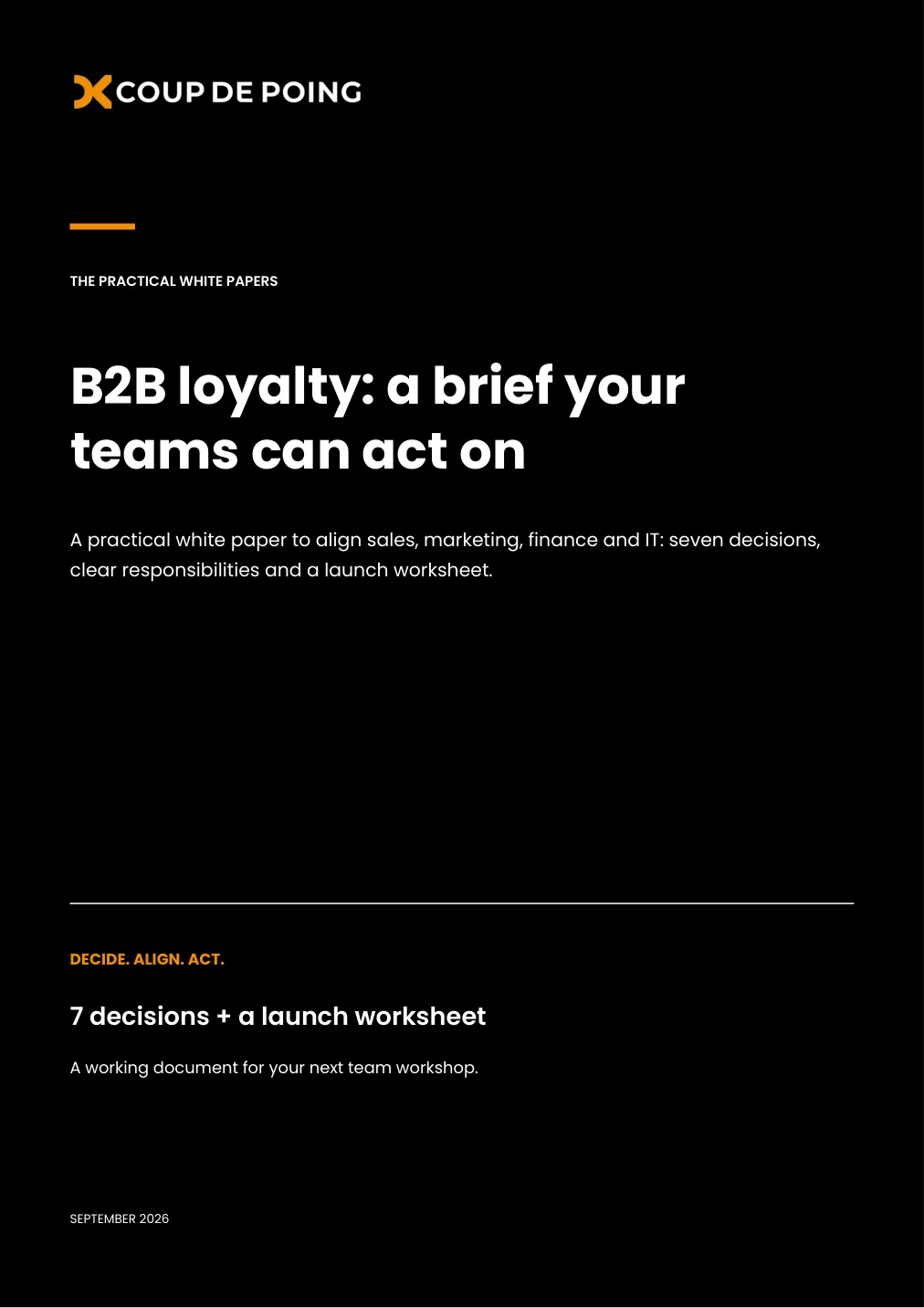
 White papers

 Grow your network.

 Enthusiasm is contagious.

 Energy becomes collective.

 Recognize what connects us.

 Measure to move forward more effectively.


 Trust is built.
 Infographics
 News
 Glossary